

Hiring software engineers in Europe has never been harder. Salaries are rising, competition is brutal, and internal teams are already stretched thin. When deadlines slip or product roadmaps expand, the pressure lands squarely on tech founders, CTOs, and product managers. That’s when nearshore staff augmentation has become the go-to solution to move fast, stay flexible, and maintain quality.
Not all nearshore models are built for long-term collaboration. This guide breaks down how nearshore staff augmentation works in practice, what to expect, and how a culturally aligned partner like Pharos Solutions helps European companies scale engineering capacity without sacrificing quality, communication, or control.
Why European Tech Leaders Are Turning to Nearshore Staff Augmentation
The problem isn’t a lack of talent; it’s access to the right talent at the right time.
According to Eurostat, 62.8 percent of EU enterprises that tried to hire ICT specialists reported difficulties filling those roles, a talent shortage hitting nearly every fast-growing tech team. Combine that with competition from global tech players and ongoing salary inflation in Eastern Europe, and it becomes clear why hiring locally is slowing teams down.
Nearshore staff augmentation solves this by giving product and engineering leaders immediate access to vetted software development teams in nearby time zones, with compatible work culture and communication styles.
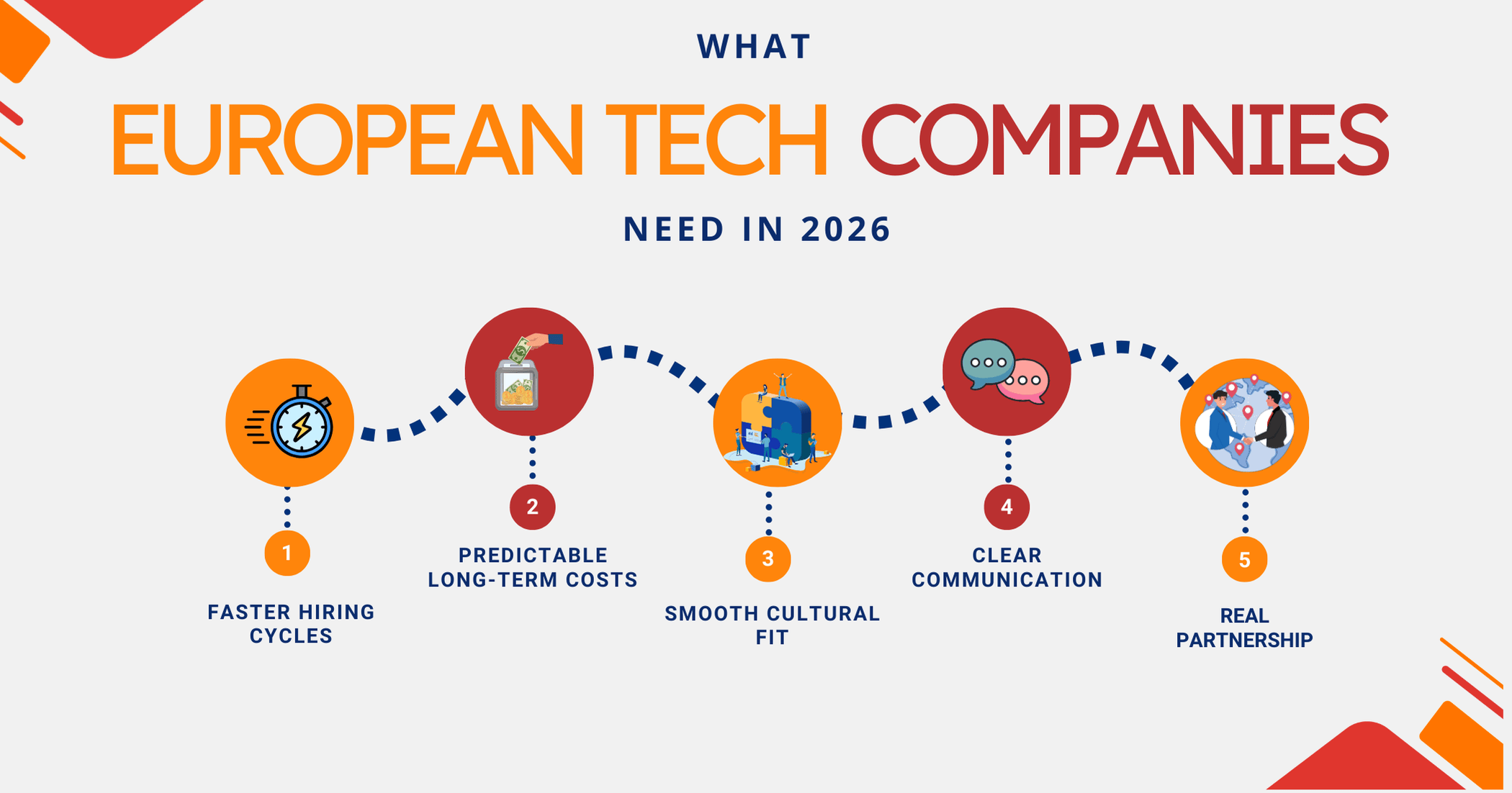
The 5 Most Important Things European Teams Actually Need today
Companies aren’t just looking for more talent, they’re looking for the right kind of support structure that removes friction, keeps budgets predictable, and strengthens collaboration across borders.
The following five priorities reflect what European organizations look for from any nearshore partner aiming to truly accelerate their delivery and scale.

How Nearshore Staff Augmentation Works
Instead of outsourcing entire projects, nearshore staff augmentation allows you to extend your existing team with remote engineers who work like your own employees, same Slack channels, same standups, same delivery expectations.
The benefits become clear fast:
- Speed: Hire vetted senior engineers in weeks, not months.
- Flexibility: Scale your team up or down according to release schedules, funding cycles, or product shifts.
- Quality Control: Keep full ownership of architecture, delivery, and engineering standards.
- Cultural Alignment: Work with developers who share similar communication styles and overlapping working hours.
- Cost Efficiency: Access top talent at competitive rates without compromising quality.
- Risk Reduction: Opt for simple, low-friction contracts to avoid long-term hiring commitments.
- Specialized Expertise: Bring in experienced engineers with the exact skill sets your roadmap demands.
- Faster Time-to-Market: Unlock extra engineering capacity to accelerate feature delivery and reduce bottlenecks.
This is exactly why nearshore software development models gained momentum across Europe in 2025.
A Practical Framework for Choosing the Right Nearshore Partner
This is a simple checklist European tech leaders can use to evaluate nearshore software development services.

This framework helps you filter out providers focused on quick wins rather than meaningful partnerships.
Where Egypt Fits Into the Nearshore Software Development Equation
Europe has historically looked toward Eastern Europe, but the market has changed.
Salaries in Poland, Romania, and the Czech Republic have risen significantly, making them less cost-effective than they used to be.
Egypt, on the other hand, has emerged as one of the strongest nearshore destinations for Europe because of:
- A fast-growing talent pool with 60k+ IT graduates annually
- High cultural alignment with European work styles
- Strong English and German communication. About 35-40% of Egyptians speak English as a second language
- An excellent time zone overlap (CET +1 hour)
- Competitive costs without sacrificing quality
- Long-term stability and low attrition rates
This combination is exactly why many German, Swiss, Dutch, and Nordic companies now choose Egypt for nearshore software development.
Why Pharos Solutions’ German-Egyptian Setup Works So Well for European Teams

Pharos brings a unique cross-cultural foundation to the nearshore model. It blends German engineering discipline with Egyptian technical strength and scalability. This collaboration feels natural, predictable, and partner-oriented
At Pharos Solutions, our nearshore staff augmentation model ensures:
- Engineers integrate seamlessly into your existing team
- You stay fully in control of architecture and priorities
- We provide cultural bridges when needed
- Our talent pipeline allows fast, high-quality team expansion
- Long-term retention keeps knowledge inside your project
This is why many of our clients stay with us for 5+ years.
Conclusion: Scale Faster, Deliver Better, Stay in Control
Nearshore software development and staff augmentation are no longer backup options, they are core strategies for European companies that want to grow without slowing down their teams.
When done right, you don’t just add capacity, you gain a real extension of your team.

